Unama’KIDS–carpenters for conservation
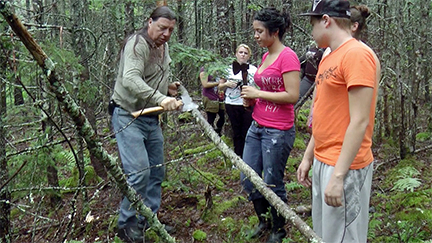
Unama’KIDS–carpenters for conservation Unama’KIDS enjoyed a full-day workshop with Paul Koziel from Nova Scotia Natural Resources, building nesting boxes for the final release of American Martens in Unama’ki. The American Marten is an endangered species here and UINR has been involved with Parks Canada and Nova Scotia Natural Resources in a project that has seen...
Moose management–the next step
Moose management–the next step The release in August of Tiamuwel Netuklimkewe–Unama’ki Moose Harvesting According to Netukulimk was an historic moment for the Mi’kmaq of Nova Scotia. It showed that we accept the responsibility as stewards of the resource and that the time has come to assert our rights. Clifford Paul, Moose Management Coordinator explains, “The...
News Bits Autumn 2009
UINR is planing a hardwood silviculture tour in the Truro area on November 10. A bus will be leaving from Eskasoni taking interested people on an all-day trip. Contact mark@uinr.ca for more information and to book your seat…Youth and Elder moose hunts have been very successful this fall in Unama’ki with community-organized hunts from Eskasoni,...
Making a difference
Making a difference Another St. Anne’s Mission has come and gone and, thanks to the dedication of the teams of workers organized by the Pitu’paq partnership, it was cleaner both during the Mission and afterwards. Once again, students from the Nova Scotia Youth Corps were involved in the recycling and waste disposal program. They worked...
Unama’KIDS shoreline cleanup
Unama’KIDS shoreline cleanup Unama’KIDS got off to a productive start this year participating in the TD Great Canadian Shoreline Cleanup. They joined nearly 60,000 volunteers from across the country who helped clean up almost 1,600 different sites. While picking up debris and garbage along the Whycocomagh shoreline, they counted every piece of garbage and catalogued...
First CAMP in region
First CAMP in region Community Aquatic Monitoring Program– CAMP is a project where communities monitor the health and marine productivity of their local aquatic ecosystem. From May–September, we monitored six sites around the Bras d’ Or Lakes using protocols developed by Fisheries and Oceans Canada. Long-term monitoring of fish and crustacean species, water temperature, salinity...
New science projects at UINR
New science projects at UINR It is going to be a busy year for UINR! We recently received support from Aboriginal Funds for Species at Risk to continue our eel research in the Bras d’Or Lakes. The project will determine biological characteristics and the relationship of American Eel (Kataq) abundance in the Bras d’Or Lakes....
A giant leap
A giant leap After years of consultation, research and planning, Assembly of Nova Scotia Mi’kmaq Chiefs released Mi’kmaq guidelines for moose hunting in Cape Breton. Tia’muwe’l Netuklimkewe’l–Unama’ki Moose Harvesting According to Netukulimk was created by the Mi’kmaq people of Nova Scotia and is an important step for Mi’kmaq self-governance over our traditional resources. If you...
Unama’KIDS Graduate
The first class of Unama’KIDS graduated at a ceremony in Eskasoni and joined a new group of kids that will be involved in next year’s project. The focus of the day was eels and we looked at the species from a traditional and a scientific point of view. Blair Bernard showed how to spear, clean...
UINR/ Parks Canada Eel Study
UINR is working with Parks Canada to study the population of American eel in Cape Breton Highlands National Park. Throughout June, UINR staff will catch, measure and release elvers (young eels) as they enter the rivers and brooks between Ingonish Beach and Neil’s Harbour. The project is looking at the migration of the elvers from...
It’s all about the people…Hubert Nicholas
Hubert Nicholas must have salt water in his blood! He’s been out on the ocean fishing for as long as he can remember. He started working professionally as a fisherman’s helper in 1988 and eventually became Captain of his own commercial fishing business. Over the years, he’s fished lobster, snow crab, herring, rock crab, tuna...
Guidelines for Cape Breton Moose Hunting released
The Cape Breton Highlands have always been known as traditional Mi’kmaq hunting grounds. In fact, a Mi’kmaq hunter recently found a 4500 year-old arrowhead there, evidence that Mi’kmaq hunted there for thousands of years. However, in the 1800s, moose disappeared from Unama’ki and this ancient relationship came to an abrupt end that lasted for almost...